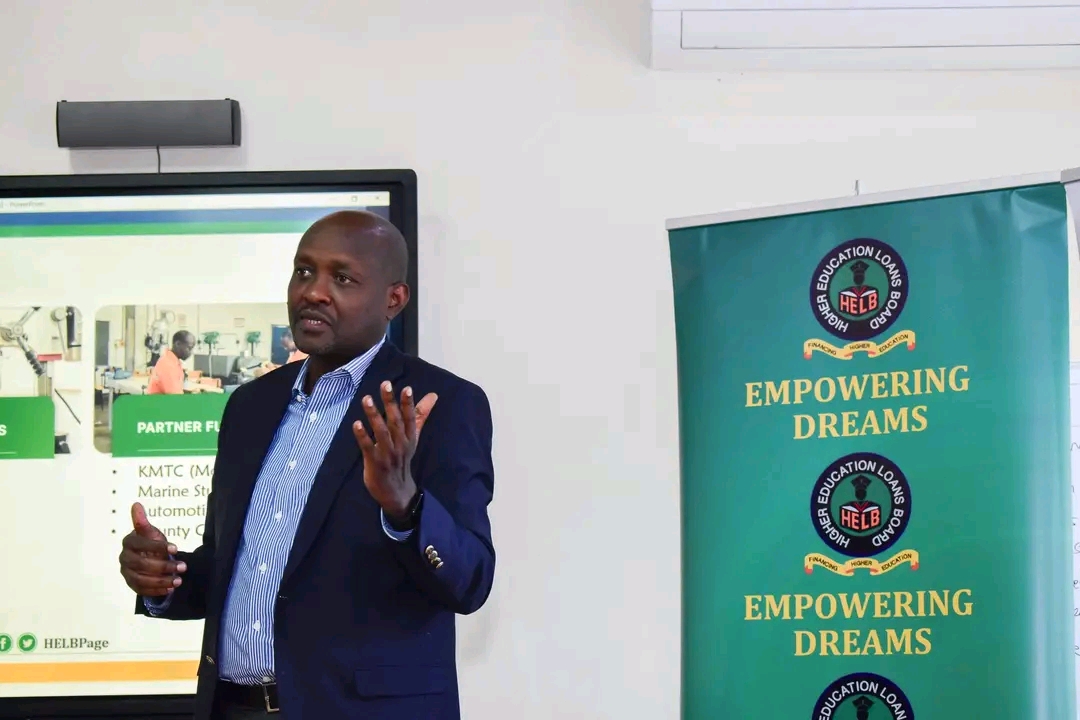
The Higher Education Loans Board HELB, Chief Executive Officer Geoffrey Monari, has called on the over 290,273 loan defaulters to honour their student loan obligations to allow other needy students to access higher education.
Speaking at the Naivasha based Morendat Institute of Oil and Gas during a media sensitization forum, Monari revealed that former students have defaulted Ksh. 29 billion.
This money is enough to allow over 48,000 needy students to complete their higher education seamlessly, gain employment, and contribute towards nation-building.
“Currently, we have a default rate of 25 billion shillings from over 272,000 former students. We need this money to allow other vulnerable students to transit from secondary to tertiary institutions,” Monari told the press.
The defaulters are part of the over 1.2 million Kenyans who have benefitted from the revolving fund since its inception.
Currently, HELB is implementing a multi-channel recovery approach to make loan repayment accessible, strengthen compliance, and prudently use recovered funds to finance education for current and future students.
“Employers deduct 15% of basic salary from identified loanees and remit payments to HELB. Non-compliant employers may face penalties of Ksh. 3,000 per employer per month,” he added.
To prevent future defaults, HELB should come up with policies to track beneficiaries who are not in formal employment.
The Universities Fund Acting Chief Executive Officer, Dr. Edwin Wanyonyi revealed that under the new funding model that is student centred, more students have accessed higher education.
However, Wanyonyi said that it is shocking that some students do not apply for scholarships and opt for the loan component only.
“Over 8,0000 students especially who come from well-off families applied for the loan and avoid the scholarship. We realized they do this because they want to use the money for their upkeep because their parents are able to pay for their tuition fees,” Wanyonyi stated.
As of 20 August 2026, HELB has received 903,230 loan applications. This includes 497,921 continuing students and 405,309 new applicants, both in universities and TVET institutions.
This comes as 2025 Kenya Certificate of Secondary Education (KCSE) and previous years’ candidates join higher learning institutions. years’ candidates join higher learning institutions.