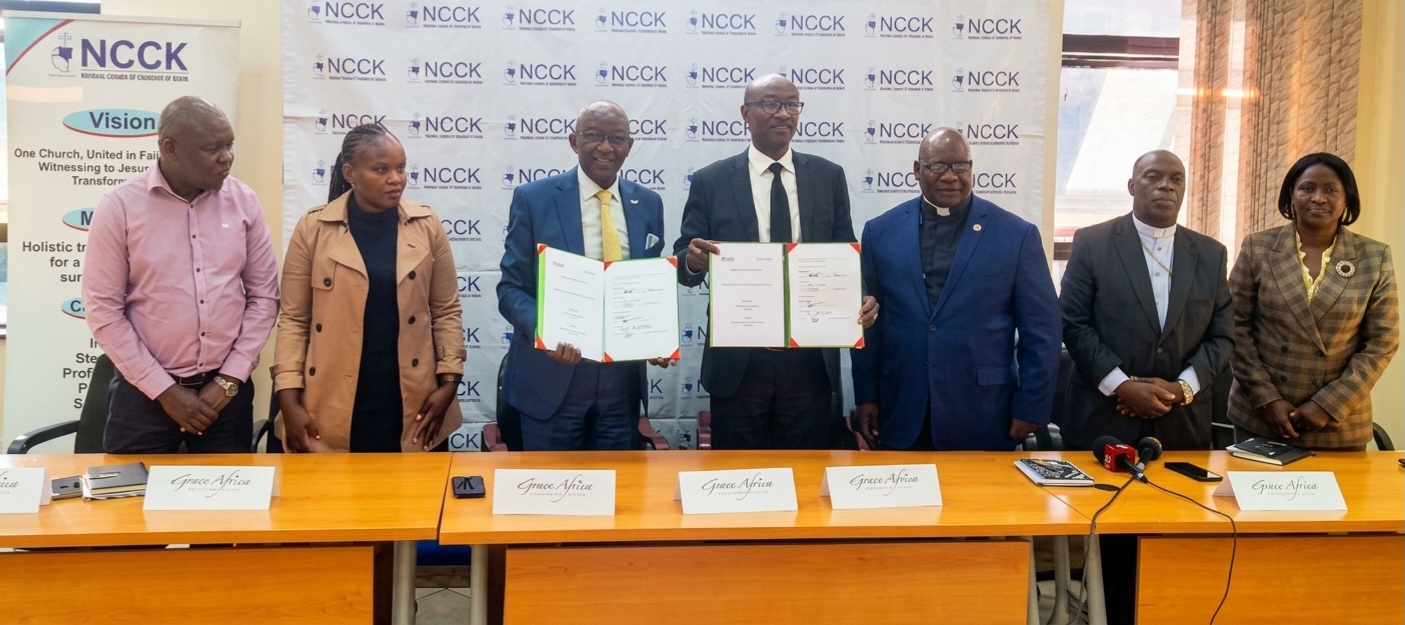
The Church is seeking to extend its role beyond spiritual nourishment to environmental stewardship, as the National Council of Churches of Kenya (NCCK) encourages pastors to incorporate environmental conservation and climate-related issues into Christian teachings, helping congregations connect their faith with responsibility towards the environment.
Drawing on the biblical account of creation in Genesis 1, the General Secretary of NCCK Rev. Canon Chris Kinyanjui challenged preachers to help church members reflect on the contrast between the earth as God created it and its present condition.
“We should do it in our pulpits. The churches can preach and talk about Genesis 1, that God created the earth and it looked like this, but now it looks like this,” he said.
His appeal comes at a time when climate change and environmental degradation are increasingly threatening livelihoods, food security and access to natural resources for many Kenyans.
In response to these challenges, NCCK has partnered with the Green Africa Foundation (GAF) in a 10-year initiative targeting the establishment of 1,450 Green Africa Villages across the country.
The partnership was formalized through a Memorandum of Understanding signed on November 18, 2026, with a focus on addressing environmental degradation, poverty and energy insecurity through sustainable livelihoods and community-led conservation.
With their extensive grassroots networks and influence, churches are strategically positioned to mobilize communities, promote environmental awareness and encourage collective action towards building resilient and sustainable livelihoods.
At the center of the partnership is the Green Africa Villages model, an initiative developed by the Green Africa Foundation in 2007 and built around nurturing people, fostering healthy and resilient communities, and promoting environmental conservation.
Green Africa Foundation Programs Manager Mercy Wanjiku said the model places communities at the center of development, with churches providing an inclusive platform through which the foundation can reach households and grassroots communities.
“It is a very inclusive model. We take it from the household, from a village, from a center, from a church. Through the church, we are able to access the communities we are seeking to work with in order to improve their livelihoods,” she said.
Under the model, communities will be encouraged to undertake activities such as tree production, renewable energy adoption, horticulture, beekeeping, fish farming, animal husbandry and water harvesting.
Other interventions include waste management, ecotourism and community capacity development, with GAF providing technical expertise and environmentally sound technologies.
These activities are expected to support household incomes while strengthening environmental conservation.
NCCK Chairman Rev. Dr. Elias Otieno Agola described the partnership as an opportunity to mobilize existing resources and empower communities, particularly those in rural areas, while creating benefits that can extend to future generations.
“This is going to be a revolution for our people at the grassroots level, and it is an opportunity for us to use what we already own,” he said.
The partners envision establishing a model Green Africa Village in every ward, demonstrating how environmental conservation can go hand in hand with economic empowerment and sustainable community development.