Chief Justice Martha Koome says the courts recorded a 103 per cent case clearance rate in the 2025/2026 financial year, but warns that a KSh 12.9 billion funding deficit, staff shortages and inadequate court infrastructure continue to hamper access to justice.
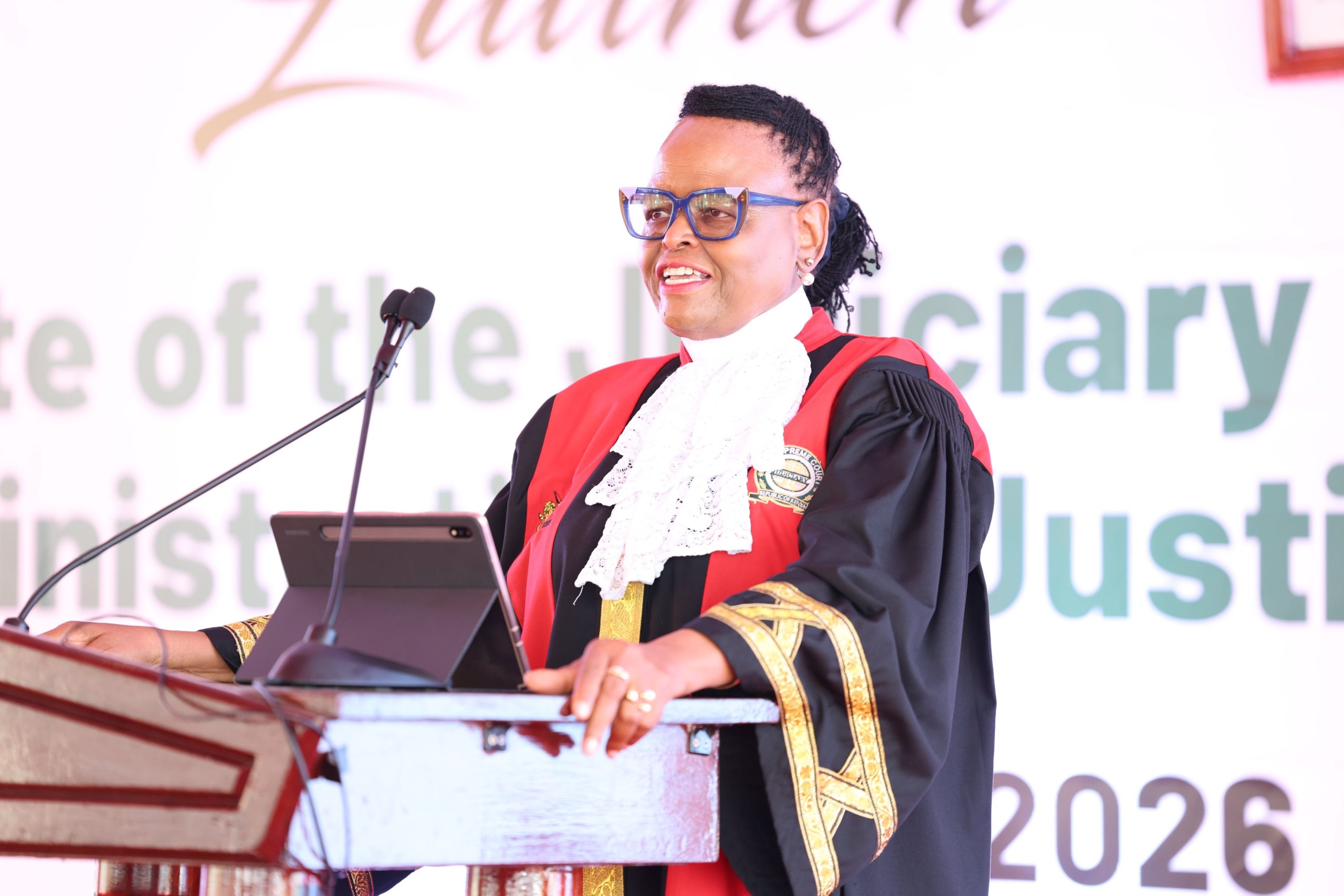
The Judiciary has resolved more cases than were filed for the second consecutive financial year, with Chief Justice Martha Koome reporting significant improvements in case management, access to justice and institutional reforms.
Presenting the 2025/2026 State of the Judiciary and Administration of Justice Annual Report (SOJAR) at the Supreme Court in Nairobi on Friday, November 20, Koome said the courts resolved 576,702 cases against 561,508 cases filed during the financial year, translating to a case clearance rate of 103 per cent.
She said the achievement reflected sustained efforts by judges, judicial officers and Judiciary staff, as well as improvements in institutional systems and collaboration with other players in the justice sector.
“During the reporting period, 561,508 cases were filed, while 576,702 cases were resolved, translating to an overall case clearance rate of 103%,” Koome said.
Consequently, the Judiciary’s pending caseload declined by 2.5 per cent, from approximately 596,000 cases at the beginning of the financial year to 579,000 by the end of the reporting period.
The report also recorded a 15.8 per cent reduction in cases that had remained unresolved for more than one year, an improvement attributed to enhanced case management and targeted backlog reduction initiatives.
The Chief Justice also reported progress in expanding the Judiciary’s geographical reach through the establishment of additional courts and specialised dispute resolution facilities.
During the financial year, two new Court of Appeal stations were established in Kakamega and Meru, while five additional Magistrates’ Courts became operational, bringing their total number to 148 countrywide.
The number of Small Claims Courts increased by 15 to 55 while two additional tribunals were operationalised bringing the total number of tribunals that have transitioned to the Judiciary to 28.
The Judiciary also established a Tribunals Shared Services Centre in Nyeri to complement existing centres in Nairobi and Kisumu.
Despite the expansion, Koome noted that 101 constituencies still lack Magistrates’ Courts, leaving significant gaps in access to judicial services.
“We shall, therefore, continue prioritizing underserved areas, including through the operationalization of additional courts and the strengthening of mobile and circuit court services,” she said.
Koome, however, acknowledged that despite the progress, the Judiciary continues to face challenges that affect the timely delivery of justice.
Among the concerns is the absence of witnesses, which remains the leading cause of court adjournments, although the overall adjournment rate declined from eight to seven per cent.
She said courts had adopted case management systems to identify matters that could be determined quickly and those requiring longer periods, allowing cases to be prioritised according to their complexity.
Koome said court-annexed mediation had expanded to all 47 counties during the reporting period, following the establishment of 42 additional mediation registries, bringing the national total to 128.
Disputes valued at approximately KSh 20.8 billion were referred to mediation, with settlements worth KSh 13.5 billion reached during the year.
She noted that the settlements had economic benefits by allowing money tied up in disputes to return to circulation.
The Judiciary also operationalised Alternative Justice Systems in 29 court stations, while 14 counties developed county action plans to strengthen the approach.
Meanwhile, the number of specialised Gender Justice Courts increased to 13 as the Judiciary strengthened its response to sexual and gender-based violence through trauma-informed judicial processes.
On digital transformation, Koome said electronic filing and case-tracking systems were operational across all courts and tribunals, while 183 courts and Judiciary offices had been connected to its digital network.
The Judiciary digitised an additional 192,000 case files during the year, bringing the cumulative number of digitised files to 749,000.
The Judiciary Contact Centre also received and resolved 13,574 inquiries from court users, while the Jumuika Enterprise Resource Planning system continued automating administrative and financial operations.
The Chief Justice further announced progress in the adoption of artificial intelligence through the pilot implementation of Mahakama AI, a legal research tool intended to support judges and judicial officers.
She said the Judiciary was also using artificial intelligence to assist in transcribing court proceedings, with human intervention retained in the process.
“We are embracing AI,” Koome said, adding that the Judiciary was developing a policy framework to guide its responsible adoption.
The report also highlighted improvements in human resource capacity following the appointment of 1,280 personnel during the financial year.
The appointments included 53 judges, 100 resident magistrates and 972 former contract digitisation agents who were absorbed into permanent service.
Additionally, 222 judicial officers and 580 members of staff benefited from promotions.
However, Koome said the Judiciary continued operating below its approved staffing establishment, with approximately 8,000 employees against a requirement of 12,000, representing about 66 per cent of its workforce needs.
She said the shortage continued to affect the institution’s ability to manage increasing caseloads, reduce delays and expand judicial services across the country.
The enactment of the Judges Retirement Benefits Act, 2026, was also highlighted as a major milestone in addressing longstanding concerns surrounding judges’ retirement benefits and welfare.
Koome reiterates zero tolerance for corruption
On accountability and integrity, the Chief Justice maintained that the Judiciary would not tolerate corruption, bribery, favouritism or misconduct among judicial officers and staff.
She disclosed that the Office of the Judiciary Ombudsman received 1,243 complaints from members of the public during the reporting period, out of which 1,100, representing 89 per cent, were resolved.
The Judicial Service Commission also handled 259 petitions against judges, concluding 168 of them.
Additionally, 16 disciplinary cases were initiated against judicial officers, with seven concluded during the year.
The Judiciary also strengthened its court integrity committees, complaints-handling mechanisms and workplace protection policies to address misconduct, discrimination and sexual harassment.
“There is no place for corruption, bribery, favoritism or any form of misconduct in the administration of justice,” Koome said.
She further warned that no Kenyan should be compelled to make unlawful payments to obtain judicial services.
“No Kenyan should be asked to make unlawful payment to obtain a service to which they are entitled,” she said.
Despite the improvements recorded, inadequate funding emerged as one of the biggest challenges facing the Judiciary.
Koome said the institution’s budget allocation increased by 19 per cent to KSh 27.15 billion during the 2025/2026 financial year.
However, the allocation represented only 0.93 per cent of the national budget, leaving the Judiciary with a funding deficit of approximately KSh 12.9 billion.
She said the shortfall was affecting recruitment, construction and maintenance of court facilities, technological modernisation and the expansion of judicial services to underserved communities.
The Chief Justice called on Parliament and the National Treasury to provide adequate and predictable funding, arguing that sufficient financing was necessary for the Judiciary to fulfil its constitutional mandate.
“Adequate financing of the Judiciary is not simply an institutional demand. It is a constitutional necessity,” she said.
In her concluding remarks, Koome acknowledged the contribution of judges, judicial officers, Judiciary staff, Parliament, the Executive, development partners and other stakeholders in strengthening the administration of justice.
She said the Judiciary remained committed to addressing its shortcomings while improving accountability, efficiency and public confidence.
The Chief Justice emphasised that judicial independence must go hand in hand with institutional accountability and that the Judiciary must remain answerable to Kenyans.
She said the ultimate objective was to ensure that every Kenyan could access timely, affordable and effective justice regardless of their geographical location or economic circumstances.